

Solar energy is one of the fastest-growing renewable power sources, and maximizing the output of each solar panel is critical to improving system economics. One of the most effective ways to increase energy capture is by using solar tracking systems, which continuously adjust the orientation of panels to follow the sun across the sky.
In these systems, stepper motors have become an increasingly popular choice for driving the tracking mechanism. Their precise positioning, stable low-speed operation, and compatibility with digital controllers make them ideal for solar panel tracking in both small-scale and large-scale installations.
What Is a Solar Tracking System?
A solar tracking system is a mechanical and control setup that rotates solar panels to keep their surface as close as possible to a perpendicular angle with the sun’s rays throughout the day.
Unlike fixed-tilt systems, trackers actively change the angle of the panels to reduce energy loss and improve total power generation.
Global Solar Tracker Market Outlook
| Metric / Horizon | Value / Expectation |
|---|---|
| Global market size (2024–2026) | USD 10–13 billion |
| Projected market size (2034–2035) | USD 40–110 billion |
| CAGR | 8%–26% |
| North America share (2025) | 30%–35% |
| Asia Pacific growth | Above 15% CAGR |
These figures show that solar tracking systems are becoming a core component in modern solar farms.
Energy Gain and Applications
| Tracker Type | Energy Gain | Applications |
|---|---|---|
| Single-axis | 15%–25% | Utility-scale solar farms |
| Dual-axis | 25%–40% | High-efficiency systems |
| Fixed-tilt | Baseline | Residential systems |
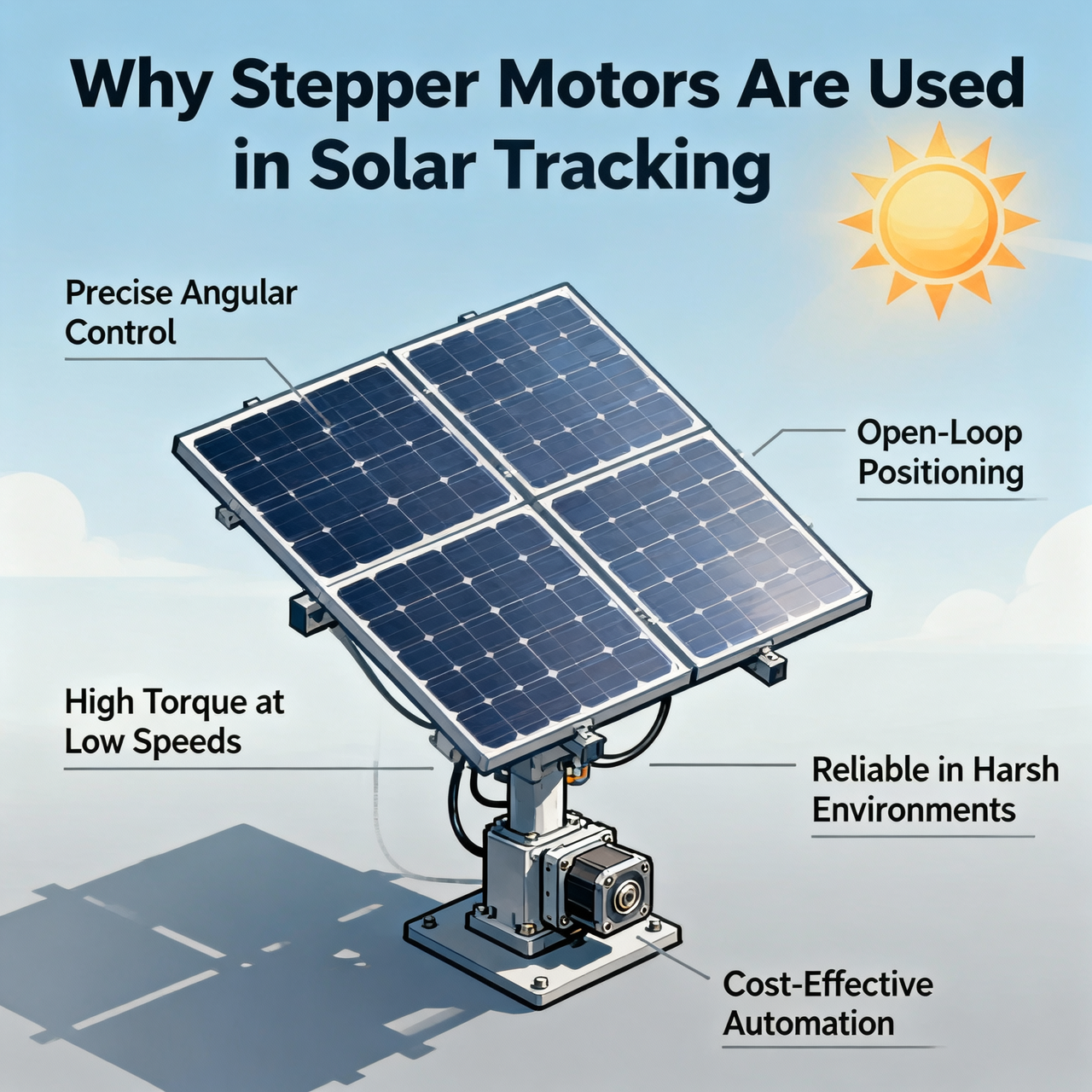
Why Stepper Motors Are Used
Solar tracking systems require accurate and repeatable positioning. Stepper motors are ideal because they move in precise steps and offer excellent control at low speeds.
Key advantages include:
High positioning accuracy
Stable low-speed operation
Easy digital control
Cost-effective solution
Single-Axis vs Dual-Axis
Single-axis trackers rotate on one axis and are widely used due to lower cost and simpler structure.
Dual-axis trackers adjust both directions and provide higher efficiency but require more complex systems.
Key Motor Selection Factors
1. Load and Torque
Motors must provide sufficient torque to handle panel weight and wind load.
2. Accuracy
Typical step angles like 1.8° or 0.9° provide a good balance of precision and cost.
3. Environmental Protection
Outdoor use requires resistance to dust, humidity, and temperature changes.
4. Control Type
Open-loop is cost-effective, while closed-loop improves reliability.
Recommended Motor Types
Hybrid stepper motors: General applications
Closed-loop stepper motors: Heavy-duty systems
Geared motors: High torque requirements
Challenges
Solar tracking systems must operate reliably in harsh environments with minimal maintenance.
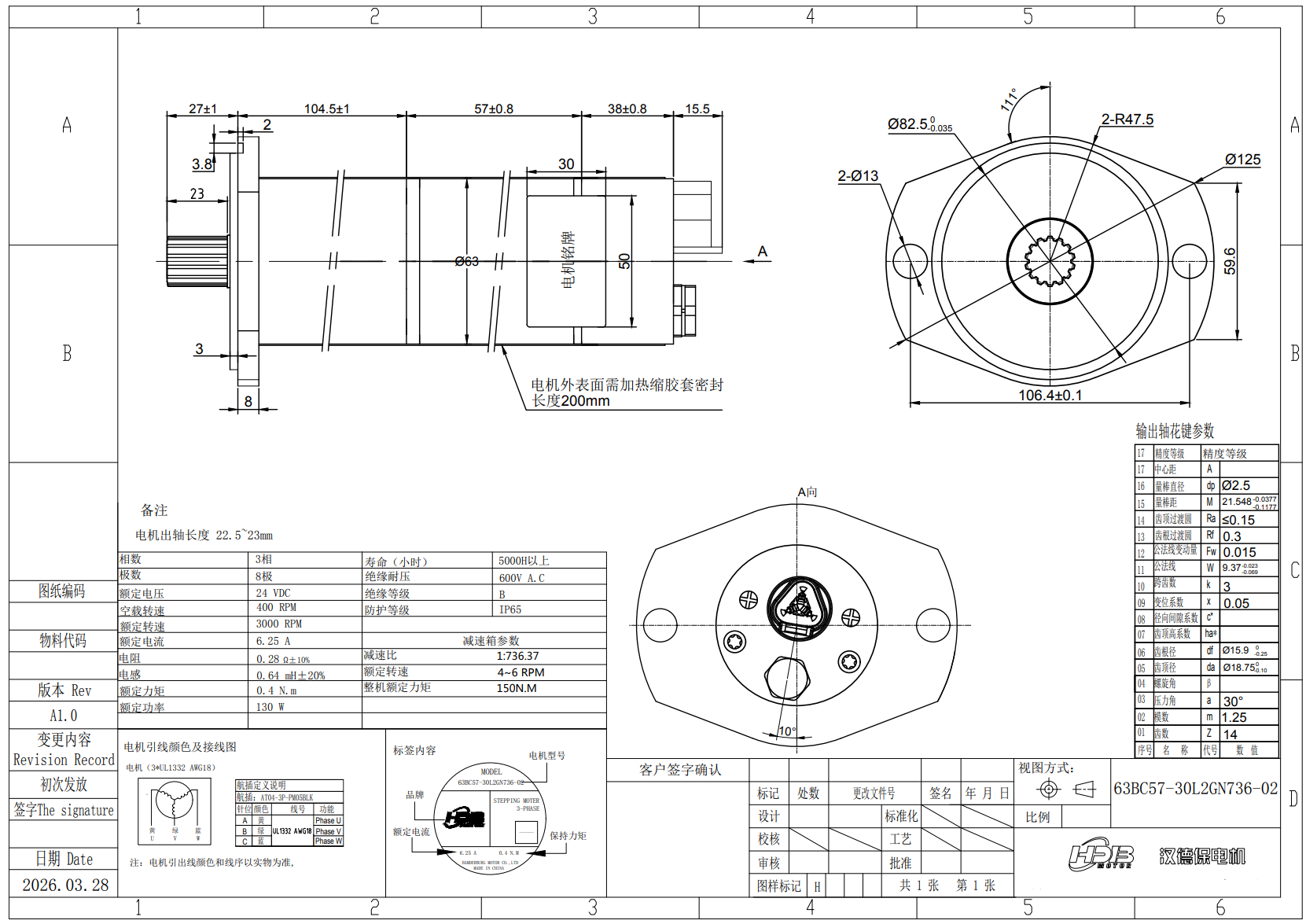
Why Choose HDBMotors?
HDB Motors has over 20 years of experience in precision motor manufacturing and provides solutions suitable for solar tracking applications.
Services include:
Custom torque solutions
OEM / ODM support
Engineering assistance
FAQ
What motor is best?
Hybrid stepper motors are commonly used, while closed-loop motors are better for demanding conditions.
Are stepper motors suitable?
Yes, due to their precision and stability.
Open-loop or closed-loop?
Open-loop is sufficient for simple systems; closed-loop is better for reliability.
Customization available?
Yes, HDB Motors supports custom solutions.