

Stepper Motor Wiring: Complete Buying & Installation Guide
Introduction
Stepper motor wiring is one of the most common sources of installation errors in CNC machines, 3D printers, and industrial automation systems.
Incorrect wiring can cause motor vibration without rotation, excessive heating, loss of torque, driver failure, and communication faults.
Whether you are working with a 4-wire bipolar motor or an 8-wire configurable system, understanding internal coil structure and driver compatibility is critical before purchasing or installing components.
This guide explains how stepper motor wiring works, compares wiring configurations, and provides practical engineering advice for selecting the right motor and driver combination.
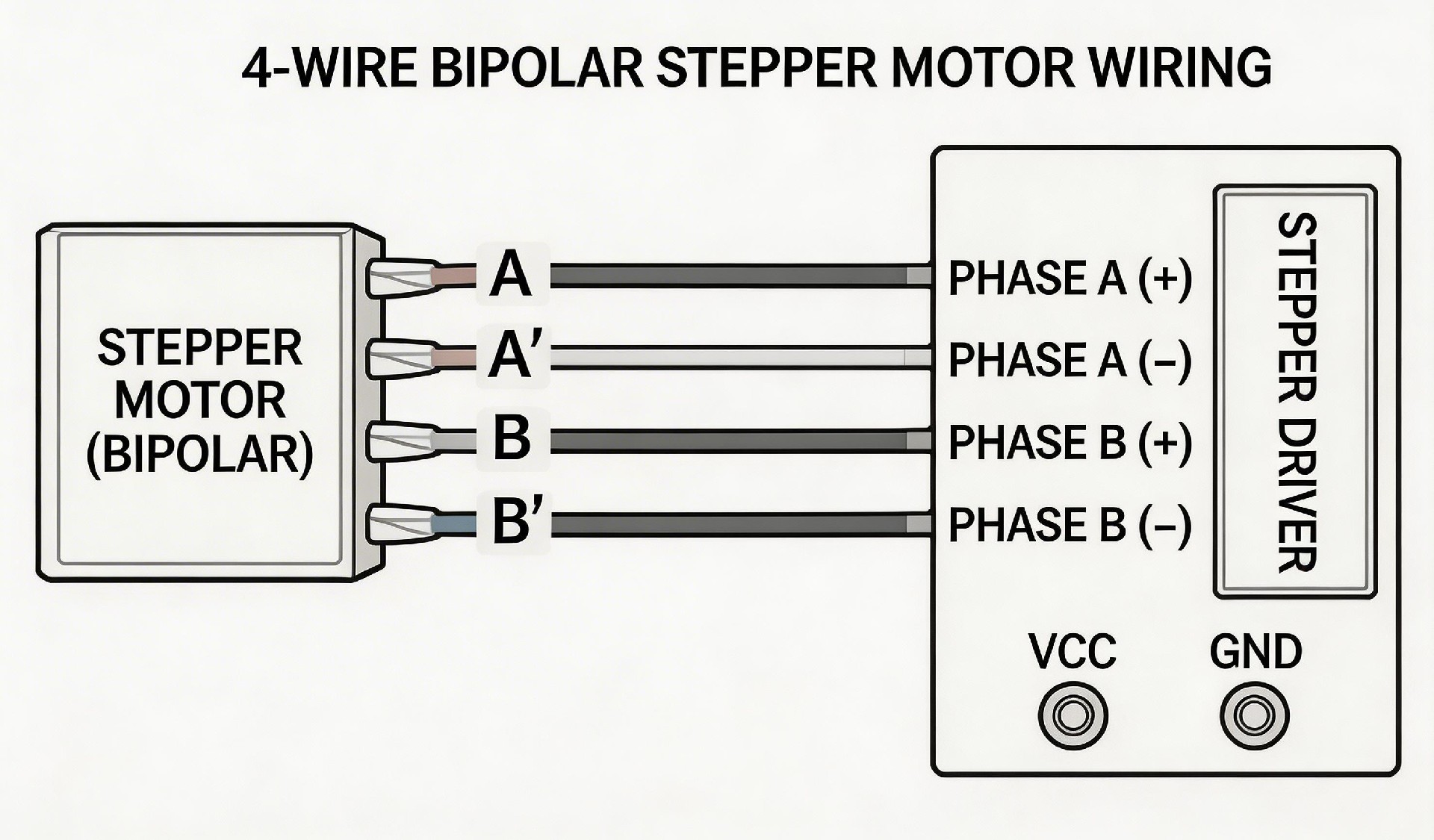
Stepper Motor Internal Coil Structure Explained
A typical two-phase stepper motor contains two independent windings (Phase A and Phase B). Proper wiring ensures the driver energizes these phases in the correct sequence.
In most open-loop stepper motor solutions, each phase must be driven with accurate current control to maintain positioning accuracy.
| Motor Type | Wire Count | Configuration |
|---|---|---|
| Bipolar | 4 wires | 2 separate coils |
| Unipolar | 6 wires | Center-tapped coils |
| Configurable | 8 wires | Series or parallel options |
4-Wire Stepper Motor Wiring (Bipolar Configuration)
The 4-wire stepper motor is the most widely used configuration in CNC and industrial systems.
Two wires belong to Phase A and two wires belong to Phase B. There is no center tap.
For correct driver operation principles, refer to stepper motor driver working theory.
| Parameter | Impact |
|---|---|
| Lower inductance | Better high-speed response |
| Simpler wiring | Reduced installation errors |
| Requires bipolar driver | Higher torque per amp |
6-Wire Stepper Motor Wiring (Unipolar & Bipolar Options)
6-wire stepper motors contain center taps on each phase. They can be wired in unipolar mode or bipolar mode.
Because torque performance depends on electrical parameters, review our engineering parameter selection guide before selecting current ratings.
8-Wire Stepper Motor Wiring (Series vs Parallel)
An 8-wire stepper motor offers maximum flexibility. Each phase has two separate windings that can be wired in series or parallel.
| Configuration | Inductance | Speed Performance | Current |
|---|---|---|---|
| Series | High | Moderate | Lower |
| Parallel | Low | High | Higher |
In high-speed automation environments, engineers may compare stepper systems with brushless DC motor technology.
Driver Connection and Control Considerations
Proper stepper motor wiring also requires correct connection of power supply, pulse signal, direction signal, and enable signal.
For microcontroller-based systems, review how to control a stepper motor with Arduino.
If wiring errors occur, refer to driver communication troubleshooting guide.
Common Stepper Motor Wiring Mistakes
Mixing coil pairs may cause vibration without rotation. Incorrect current settings may cause overheating or torque loss.
To compare stepper systems with servo alternatives, consult the stepper vs servo motor selection guide.
Buying Recommendations
Before purchasing, confirm required torque, voltage availability, driver compatibility, and mounting standard.
For compact high-torque systems, consider planetary gearbox integration.
HDBMOTOR provides OEM wiring diagrams, driver matching, and complete motion system integration support.
Frequently Asked Questions
How do I identify stepper motor coil pairs?
Use a multimeter to measure resistance. Wires showing low resistance belong to the same coil.
Can I wire a 6-wire motor as bipolar?
Yes. Ignore the center tap and use the outer wires for higher torque.
Why does my motor vibrate but not spin?
Most likely the coil pairs are incorrectly connected or one phase is not energized.
Conclusion
Stepper motor wiring directly affects torque output, efficiency, and system reliability. Correct configuration ensures stable operation and long service life.
For industrial-grade stepper motor systems and OEM wiring support, HDBMOTOR provides complete motion control solutions tailored to your automation needs.