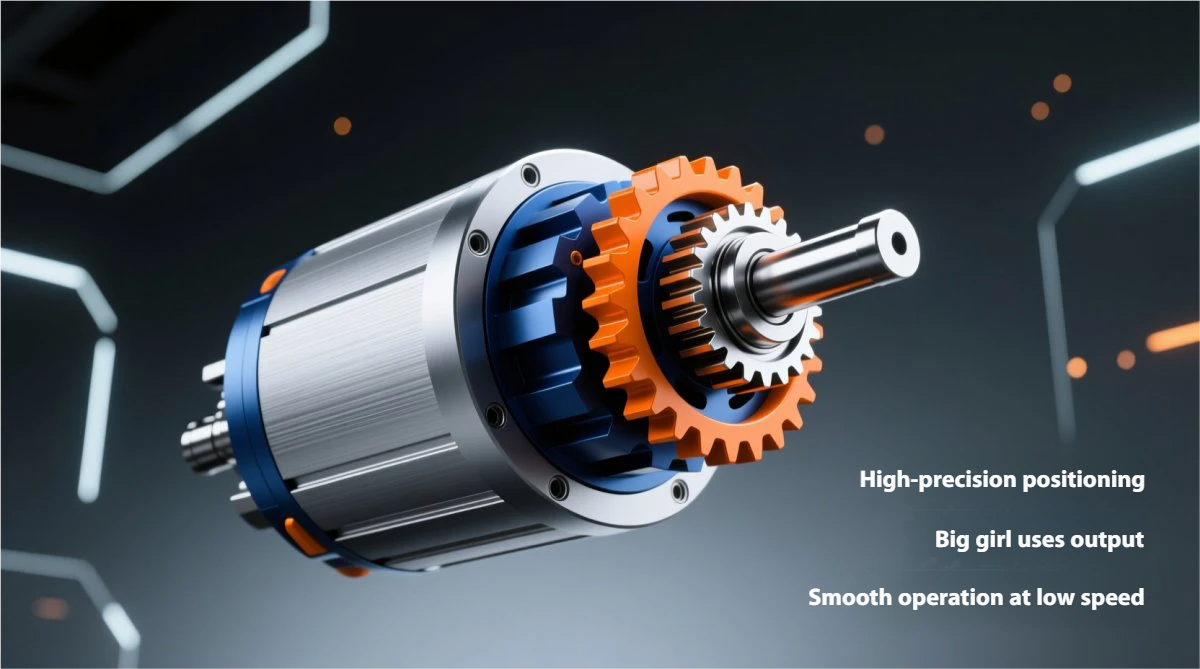
Advantages of stepper motors with gearbox
In the intricate world of industrial automation and precision motion control, the combination of a stepper motor and a gearbox represents a powerful synergy. While stepper motors are renowned for their precise open-loop positioning capabilities, integrating a gearbox unlocks a new dimension of performance, making them suitable for a far wider range of demanding applications. This article delves into the core advantages of this combination, exploring how gearboxes enhance stepper motor functionality and examining the specific solutions offered by industry leaders like HDBMOTOR.
Gearbox Overview
A gearbox, or gear reducer, is a mechanical device designed to modify the speed and torque output from a prime mover, such as an electric motor. Its primary purpose in industrial automation is to match the motor's high-speed, low-torque output to the application's requirement for lower speed and higher torque. This transformation is crucial for driving heavy loads, achieving precise movements, and improving overall system efficiency and longevity.
Types of Gearboxes
Gearboxes are categorized based on their transmission geometry and construction. Common types include:
Cylindrical (Spur) Gearboxes: Feature parallel shafts and straight-cut gears. They are valued for their simplicity, cost-effectiveness, and high efficiency.
Planetary Gearboxes: Consist of a central sun gear, planet gears, and a ring gear. They offer high torque density, excellent stiffness, and compact coaxial design.
Combination Gearboxes: Integrate different gear types (e.g., planetary and spur) to achieve specific performance characteristics.
Furthermore, gearboxes are distinguished by their stage count (single-stage vs. multi-stage for higher reduction ratios) and rotating arrangements like expansion, split, or coaxial designs, each serving different mechanical layout needs.
Stepper Motors with Gearboxes
A stepper motor coupled with a gearbox is often termed a geared stepper motor or step-down motor. The gearbox performs a speed reduction, which correspondingly multiplies the output torque. This is vital for applications where the stepper motor alone cannot provide sufficient torque to overcome inertia or move a load, or where finer control at lower speeds is required. The gear reduction also improves the motor's ability to handle fluctuating loads more smoothly.
Applications
The enhanced capabilities of geared stepper motors make them indispensable across numerous industries:
Industrial Machinery: Widely used in packaging machines for precise product indexing, printing equipment for accurate paper feed, and conveying systems for synchronized movement.
Precision Instruments: Essential in optical equipment (lens positioning), analytical instruments, and automated laboratory devices.
Security & Financial: Drive the mechanisms in electronic locks, ATM bill dispensers, and currency counters.
Food & Medical: Employed in food processing machinery and medical devices where hygiene, reliability, and precise dosing are critical.
Advantages of Gearboxes
Integrating a gearbox with a stepper motor delivers a host of compelling benefits:
Increased Output Torque: This is the most significant advantage. The gear reduction converts high motor speed into usable, high torque at the output shaft, enabling the system to drive heavier loads. For instance, a gearbox with a 10:1 ratio can theoretically increase output torque tenfold.
Compact Structure & Small Footprint: Achieving the same high torque with a larger, non-geared motor would require significantly more space. Geared stepper motors provide a high torque-to-size ratio.
High Transmission Efficiency & Precise Ratio: Modern precision gearboxes offer efficiency rates above 90%. The fixed gear ratio ensures a precise and predictable relationship between motor steps and output shaft rotation, enhancing positioning accuracy.
Reduction of Load Inertia: The gearbox reduces the reflected inertia of the load on the motor shaft by the square of the gear ratio. This allows the motor to accelerate and decelerate the load more quickly and with less oscillation, improving dynamic response and stability.
Superior to Chain/Belt Systems: Compared to chain or belt drives, gearboxes offer zero backlash (in precision models), minimal friction loss, significantly lower noise levels, and require no maintenance like tension.