

Linear stepper motors are a critical component in modern automation systems where precise linear positioning is required without complex mechanical conversions. Unlike traditional rotary stepper motors that require lead screws or belts, linear stepper motors generate motion directly in a straight line.
For engineers and OEM buyers, selecting the right linear motion solution can significantly impact system accuracy, efficiency, and reliability. This guide provides a comprehensive, engineering-focused overview to help you evaluate, compare, and select the best linear stepper motor for your application.
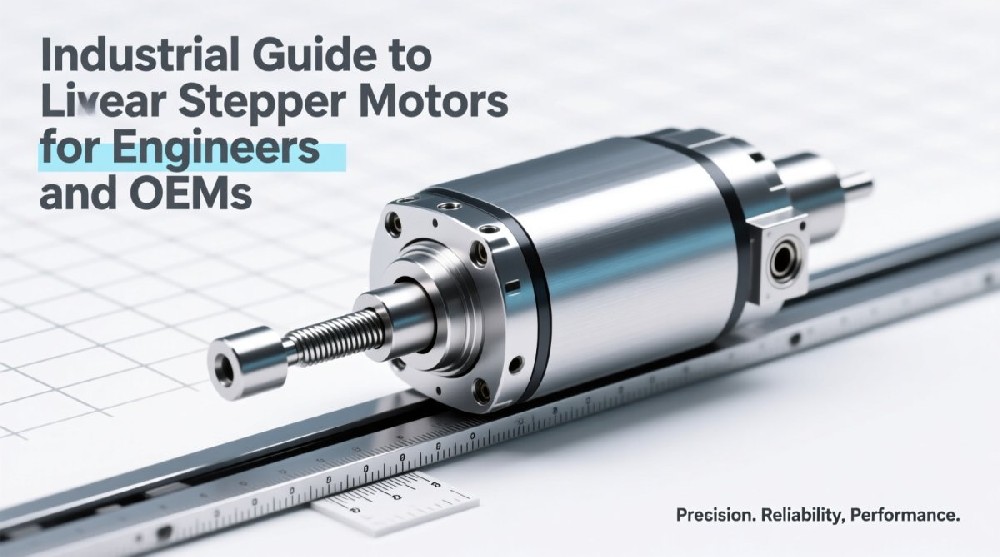
What Are Linear Stepper Motors?
Linear stepper motors are electromechanical devices that convert electrical pulses into incremental linear motion. Instead of rotating a shaft, they move a shaft or nut along a threaded rod using electromagnetic stepping principles.
These motors eliminate the need for external mechanical transmission components, simplifying system design and reducing backlash.
There are three primary configurations:
Captive linear stepper motors
Non-captive linear stepper motors
External linear stepper motors
Compared to traditional systems using open-loop stepper motor solutions, linear stepper motors integrate motion conversion directly, improving efficiency and reducing assembly complexity.
How Linear Stepper Motors Work
Linear stepper motors operate based on electromagnetic interaction between the stator and a threaded shaft or nut. When pulses are applied, the motor advances in discrete steps, producing controlled linear displacement.
Each pulse corresponds to a specific linear movement, determined by step angle, thread pitch, and drive method.
For precise motion control, understanding driver behavior is essential. Advanced control techniques such as microstepping improve smoothness and resolution.
Refer to this stepper motor control with Arduino guide for implementation.
Types of Linear Stepper Motors
Understanding the different types is essential before making a purchase decision.
Captive Linear Stepper Motors
Provide high stability and built-in guidance, ideal for compact systems.
Non-Captive Linear Stepper Motors
Allow longer travel distances but require external support.
External Linear Stepper Motors
Offer flexible mechanical integration for custom designs.
For higher thrust applications, combining with planetary gearbox integration can significantly improve output force.
Linear Stepper Motors vs Other Motion Solutions
Quick comparison for engineers evaluating linear motion solutions:
Feature | Linear Stepper Motor | Rotary + Lead Screw | Servo System |
Accuracy | High | Medium | Very High |
Complexity | Low | High | High |
Cost | Moderate | Low | High |
Maintenance | Low | Medium | High |
For deeper analysis, see stepper vs servo motor comparison.
Key Technical Specifications to Consider
Selecting the right motor requires evaluating critical engineering parameters.
Parameter | Description | Impact |
Thrust Force | Linear force output | Defines load capacity |
Step Resolution | Movement per step | Affects precision |
Stroke Length | Travel distance | Determines range |
Speed | Linear velocity | Impacts efficiency |
Use this engineering selection guide for detailed calculations.
Common Applications of Linear Stepper Motors
Medical automation systems
Semiconductor equipment
3D printing and CNC
Packaging machinery
Laboratory devices
For higher-speed applications, consider brushless DC motor technology.
How to Choose the Right Linear Stepper Motor
Define load requirements
Determine stroke length
Calculate thrust force
Evaluate speed
Select motor type
Explore precision stepper motor solutions for your application.
Cost Factors and Buying Considerations
Motor size
Precision level
Customization
Order volume
Evaluate total cost of ownership rather than initial price.
Frequently Asked Questions
What is the advantage of a linear stepper motor?
It eliminates mechanical transmission components, improving efficiency and precision.
Are they suitable for high speed?
They are better suited for moderate speeds.
How accurate are they?
They can achieve micron-level positioning accuracy.
Do they need feedback?
Typically no, they operate in open-loop systems.
Where are they used?
Medical, automation, semiconductor, and precision manufacturing industries.
How to select the right one?
Calculate load, speed, and travel requirements carefully.
Conclusion
Linear stepper motors offer a compact, efficient, and highly precise solution for modern automation systems. Their simplicity and reliability make them a preferred choice for engineers and OEM buyers worldwide.
Choosing the right model requires careful evaluation of specifications, application needs, and long-term performance expectations.